Mid-Flight Corrections: The Case for Letting Your Creative Vision Evolve
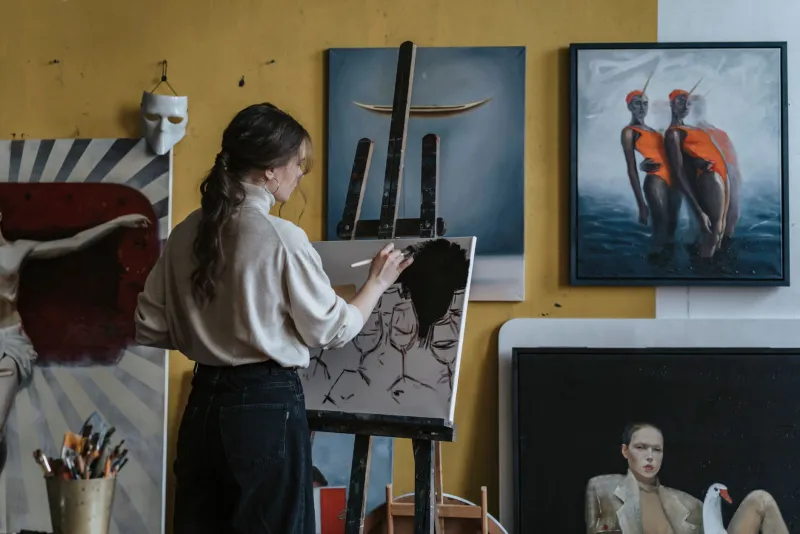
There's a story about a sculptor who, when asked how he carved such lifelike horses, said he simply removed everything that didn't look like a horse. It sounds like a joke, but there's something genuinely useful buried in there — the idea that the finished thing was always inside the raw material, and the job was mostly about listening.
Most of us don't start projects that way. We start with a locked-in concept, a mood board, a pitch deck, a chorus we wrote in the shower at 6 a.m. that felt like the whole record. We commit. Hard. And then somewhere around the middle of the thing — that swampy, disorienting territory where the original excitement has worn off but the finish line isn't visible yet — we realize the map doesn't match the terrain.
And instead of adjusting the map, we keep walking into the woods.
The Myth of the Unbroken Vision
We've been sold a romantic version of creative work where the artist sees the whole thing clearly from the jump and executes it with surgical precision. And sure, that happens sometimes. But more often, the finished work that feels inevitable — the album that sounds like it could only exist as exactly what it is, the novel where every chapter earns the next one — got that way through a series of mid-course corrections that the creator had to fight their own ego to make.
Stephen King has talked openly about scrapping hundreds of pages of The Stand when he realized the story needed to go somewhere his original outline hadn't accounted for. Francis Ford Coppola's production of Apocalypse Now was a constant, chaotic negotiation between the film he set out to make and the film that kept insisting on being made instead. The result was a mess by most conventional production standards. It was also one of the greatest American films ever put on screen.
The pivot didn't betray the vision. The pivot was the vision, once the creator got honest about what the material was asking for.
Why We Resist the Turn
So if changing course mid-project can produce better work, why do so many creators refuse to do it? A few reasons, and they're worth naming directly.
First, there's sunk cost. You've already put in the hours, the money, the emotional energy. Admitting the direction needs to shift feels like writing off everything that came before. It doesn't work that way — the work you did to get to the realization was part of the process — but it feels that way, and feelings drive a lot of creative decision-making.
Second, there's the audience problem. If you've been talking about your project publicly — on social media, in newsletters, to your friends and collaborators — pivoting feels like a public admission of failure. It's not. But again, the feeling is real, and it can paralyze you.
Third, and maybe most insidious, is the idea that consistency equals integrity. That if you change your mind, you didn't really know what you were doing in the first place. This one's worth pushing back on directly: changing your mind in response to new information, new emotional truth, or new creative possibilities isn't inconsistency. It's intelligence.
Building Flexibility Into the Process
The goal isn't to become someone who abandons every project the moment it gets hard. There's a real difference between pivoting because the work is asking for it and bailing because the work is asking for effort. Learning to tell the difference is its own skill, and it takes time.
But there are some practical ways to build recalibration into your creative process rather than treating it as a failure mode.
Schedule check-ins with yourself. At regular intervals — maybe every month on a longer project, every week on something shorter — sit down and ask honestly: is this still the thing I want to make? Has something shifted in what the work wants to be? You're not giving yourself permission to quit. You're giving yourself permission to notice.
Separate the core from the execution. Most projects have a central emotional truth or thematic anchor that doesn't need to change, and then a whole lot of choices about how to express that truth. The how is almost always more flexible than it feels. If the core is solid, changing the execution isn't betrayal — it's craft.
Talk to someone who isn't invested in your original idea. Fresh eyes are genuinely useful here, not because outside opinions should drive your creative decisions, but because someone who doesn't have an attachment to your original pitch can often see what the work is actually doing versus what you intended it to do.
Make the pivot official. One thing that helps: don't just quietly change direction and pretend you were always going this way. Acknowledge it, even if just in your own notes. Name what you're leaving behind and why. That kind of intentionality turns a drift into a decision, and decisions are easier to commit to.
The Finished Thing Is the Point
Here's the bottom line: the world doesn't need your original vision. It needs the finished work. And if changing your mind mid-project is what gets you to a finished work that actually says something true — rather than a finished work that faithfully executes an idea you outgrew, or worse, an abandoned project that never got finished at all — then changing your mind is the most professional, most artistically serious thing you can do.
The creators who complete things and complete them well aren't the ones who never doubt. They're the ones who learned to hold their original ideas loosely enough that the real work could find its shape.
Mid-flight corrections aren't crashes. Sometimes they're exactly how you land.