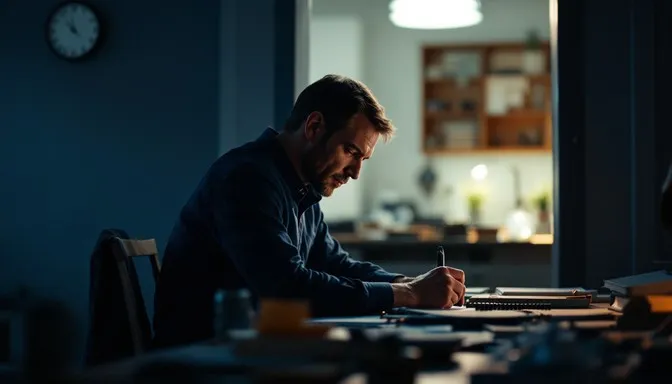
Burn Bright: Why Your Darkest Seasons Produce Your Most Honest Work
Photo: dramatic stormy sky artist creative studio moody lightning, via img.freepik.com
Comfort is a liar. It tells you everything is fine while quietly strangling the urgency that makes art worth a damn. The most enduring creative work in history wasn't born from contentment—it clawed its way out of something harder, messier, and a whole lot more real.
There's a reason we don't talk about the cozy years when we talk about the greats. We talk about the broke years. The heartbreak years. The years when everything was falling apart and somehow, impossibly, the work was falling together.
The Myth of the Serene Artist
Somewhere along the way, we picked up this romantic idea that the best artists work from a place of Zen-like calm. A tidy studio, a warm cup of coffee, a clear head. And sure, that environment can support the craft—the revision, the editing, the technical execution. But the raw material? The thing that makes a song hit you in the chest at 2 a.m.? That almost never comes from a Tuesday afternoon when nothing is wrong.
Think about where Fleetwood Mac's Rumours came from. The band was disintegrating in real time. Two couples breaking up simultaneously while they were supposed to be making a record together. By any normal measure, that should have been a disaster. Instead it became one of the best-selling albums in American music history. The chaos didn't derail the work—it was the work.
Or look at Sylvia Plath writing The Bell Jar during one of the most psychologically brutal stretches of her life. The novel isn't great despite that pain. It's great because she refused to sanitize it. She let the reader feel the weight of what she was actually carrying.
Turbulence as Raw Material
Here's the thing about emotional chaos that nobody frames correctly: it's not a problem to solve before you sit down to create. It's the material itself.
When you're going through something—a breakup, a career collapse, a loss, a period of profound uncertainty about who you are and what you're doing—your nervous system is wide open. Your defenses are down. The usual filters you use to protect yourself from vulnerability? Gone. And vulnerability, as uncomfortable as it is to live inside, is the single most magnetic quality in any piece of art.
Audiences don't connect with polished. They connect with true. And turbulence has a way of burning away everything that isn't true.
John Steinbeck wrote The Grapes of Wrath after traveling through migrant worker camps in California, watching families destroyed by the Dust Bowl and economic collapse. He wasn't writing from a comfortable distance. He was wrecked by what he saw. That devastation is on every page, and it's exactly why the book still matters nearly a century later.
The Difference Between Drowning and Swimming
Now, let's be honest about something. There's a version of this conversation that gets dangerous fast. Using emotional chaos as fuel is not the same thing as romanticizing self-destruction. The tortured artist myth has cost us too many genuinely brilliant people who believed suffering was the price of admission.
The goal isn't to manufacture misery or refuse to seek help when you need it. The goal is to not waste the hard seasons when they arrive—and they will arrive, because that's just life.
The difference between drowning in turbulence and swimming through it comes down to one thing: intentionality. Are you processing the experience through your work, or are you just marinating in it? A journal, a half-finished song, a screenplay outline—these aren't just creative outputs. They're life rafts. They give the chaos a container.
Director Paul Thomas Anderson has talked about how Magnolia—arguably his most emotionally overwhelming film—came out of a period when he was grappling with his father's illness and his own questions about family and regret. He didn't wait until he had answers. He made the film in order to ask the questions. That's the move.
What Comfort Actually Costs You
Creative comfort isn't neutral. It has a price.
When everything in your life is stable, predictable, and pleasant, the work tends to reflect that. It becomes competent. Technically sound. Inoffensive. And inoffensive is the quiet death of anything memorable. Nobody puts an inoffensive album on a road trip playlist. Nobody recommends an inoffensive novel to someone going through something hard.
The artists who build lasting careers—the ones whose work travels across decades and demographics—are the ones who were willing to go somewhere uncomfortable and bring the audience with them. Bruce Springsteen didn't write Nebraska from a place of satisfaction. Taylor Swift didn't write folklore while everything was going great. Kendrick Lamar didn't make To Pimp a Butterfly from a place of ease.
In every case, the artist leaned into the tension instead of away from it. They trusted that the audience could handle the weight. And the audience rewarded that trust with something no algorithm can manufacture: genuine connection.
How to Channel It Without Losing Yourself
So what does this actually look like in practice? A few things worth keeping in your toolkit:
Give yourself permission to create badly at first. When you're in the middle of something hard, the first drafts are going to be raw and probably a mess. That's correct. That's the material arriving. Don't edit it yet. Just get it out.
Create a ritual that signals safety. Your nervous system needs to know it's okay to open up. A consistent time, place, or pre-work habit tells your brain this is a protected space for honesty.
Separate the experience from the craft. You live the turbulence. Then you shape it. These are two different modes, and mixing them up is where people get stuck. Feel it first. Then build with it.
Find the universal in the specific. Your particular heartbreak or fear or confusion is yours—but the feeling underneath it is shared by millions of people who've never met you. That's where the art lives. Go specific enough to be honest, and you'll accidentally be universal.
The storms in your life are not interruptions to your creative work. They're invitations to do the most important work of your career. The only question is whether you show up for them.