Let It Happen: The Strange Science of Creating Without Trying
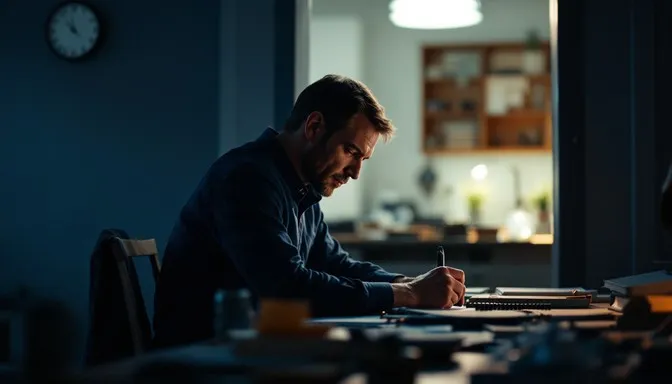
Photo: writer working late at night desk lamp creative flow, via images.stockcake.com
It's 12:47 in the morning. You've been staring at the same paragraph for forty minutes, or the same chord progression, or the same scene that refuses to breathe. You get up to make coffee. You stare out the window at nothing in particular. And then — almost against your will — something clicks. You sit back down and the words just come. The melody resolves. The scene finds its pulse.
This isn't a fluke. It's not magic, either. It's something reproducible, something that lives at the intersection of neuroscience, creative habit, and a particular kind of letting go that most of us are never actually taught.
The Paradox Nobody Talks About
We live in a hustle culture that treats effort as a moral virtue. Grind harder. Show up every day. Put in the hours. And look — that discipline matters. Nobody's saying otherwise. But there's a ceiling to what pure willpower can produce in creative work, and a lot of us have bumped our heads on it more times than we'd like to admit.
The paradox is this: some of the most authentic, most alive creative work comes not from pushing harder but from releasing the push entirely. Psychologist Mihaly Csikszentmihalyi spent decades studying what he called "flow" — that state where challenge and skill align so cleanly that the self-conscious part of your brain essentially steps out of the room. Athletes call it being "in the zone." Writers call it when the characters start talking on their own. Musicians call it the song writing itself.
What all of these descriptions have in common is the absence of the internal critic. The editor who lives in your frontal cortex, second-guessing every choice. When that voice quiets down — usually because you've either exhausted it or distracted it — the deeper creative machinery gets to run.
Why Midnight Works (And What It's Really About)
There's a reason so many artists swear by late-night sessions. It's not just romance or caffeine. By the time midnight rolls around, you're tired. Your defenses are down. You've already done the responsible, effortful part of your day, and your brain has genuinely loosened its grip on the need to perform.
Fatigue, it turns out, is a surprisingly effective creativity hack — not because exhaustion is good for you, but because it temporarily disables the overthinking mechanism. Your prefrontal cortex, which handles judgment and self-monitoring, is one of the first regions to feel the effects of a long day. What's left is something more associative, more willing to make weird leaps, less afraid of looking stupid.
Now, you don't need to wreck your sleep schedule to access this. The point isn't the hour — it's the mental state the hour produces. And that state is replicable.
Practical Ways to Court the Effortless
Start in the middle. One of the fastest ways to bypass the internal critic is to skip the setup entirely. Don't begin at the beginning. Open your document or your notebook and start writing the part you already half-know, the scene or verse or section that already has some heat to it. The critic doesn't know what to do with something that's already in motion.
Set a timer and make it short. Fifteen minutes. Twenty. Tell yourself you're just noodling around, not actually working. This sounds like a trick because it is one — and it works anyway. The brain relaxes its performance anxiety when the stakes feel low. Give yourself permission to produce garbage, and watch how often you don't.
Create a sensory ritual. Flow states are partly about transitioning out of ordinary consciousness, and rituals help your nervous system make that shift. It doesn't have to be elaborate — the same playlist, the same cup of something, the same chair. Over time, these cues become anchors that tell your brain: we're doing the other thing now. The creative thing. The loose thing.
Work past the resistance without fighting it. When you hit a wall, the instinct is to push back. Try going around instead. Write the part you're avoiding in the worst possible way, just to have something on the page. Sketch the scene badly. Play the chord wrong on purpose. The act of deliberately lowering quality short-circuits the perfectionism loop and often, ironically, produces something worth keeping.
Notice when it's happening and don't announce it. This one is subtle. Flow states are fragile, and the moment you think "oh, I'm in the zone right now" — you've usually just left it. The self-aware mind re-enters the room. So when things are moving, just let them move. Don't check your phone to tell someone about it. Don't stop to read back what you've written. Stay in the current.
The Myth of Constant Inspiration
Here's something worth sitting with: you can't live in a flow state. The brain isn't built for it. These moments are generative precisely because they're not the baseline. The work you do in the grinding, effortful hours — the research, the revisions, the deliberate practice — is what fills the reservoir that the flow state draws from.
Think of it this way. The late-night breakthrough doesn't happen in a vacuum. It happens because you've been putting material in all day, all week, all year. The effortless moment is built on top of a mountain of effort. The surrender only works because there's something to surrender to.
So the real skill isn't learning how to be brilliant without trying. It's learning how to alternate between the two modes — the effortful and the receptive — and trust that both are essential. Do the work. Then get out of the work's way.
That's the whole thing, really. And it's harder than it sounds, and easier than you think.