The Long Way Back: Why Some Creators Do Their Greatest Work After the World Moves On

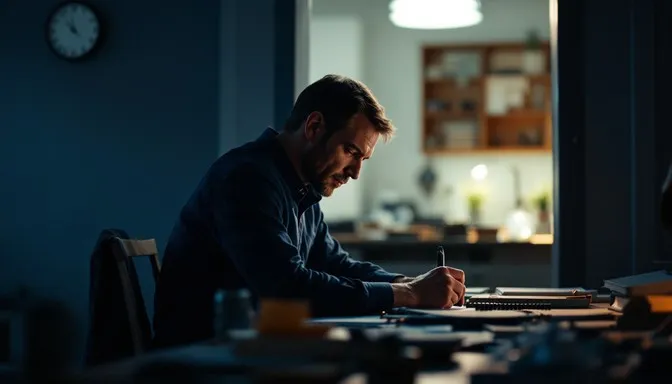
Photo: older musician recording studio alone contemplative creative process, via i.pinimg.com
The story we tell about creative careers is a clean one. You emerge, you build, you hit your peak, and then—if you're lucky—you become an elder statesman of your craft, trotted out for retrospectives and lifetime achievement awards while the next generation does the actual work. It's a tidy arc. It also doesn't describe most of the careers worth studying.
Some of the most extraordinary creative output in recent memory has come from people who were, by conventional reckoning, done. Finished. Safely filed under "important earlier work." And then something happened—a disappearance, a failure, a forced reinvention—and they came back with material that made everything they'd done before look like a warm-up.
This is worth paying attention to, especially if you're a creator in the middle of your own story, wondering whether the momentum is supposed to feel this uneven.
The Cohen Principle
Leonard Cohen is the obvious starting point for any conversation about late-career creative renaissance, and he's obvious for good reason. By the time he released You Want It Darker in 2016—the record that arrived weeks before his death at 82—he had already been declared a legend for decades. The critical apparatus had him neatly categorized. His place in the canon was secure.
And then that record came out, and it was arguably the most fully realized thing he'd ever made. Stripped down, lyrically precise in a way that felt almost inhuman, utterly unafraid of death in a way that only someone actually facing it could manage. It wasn't a comeback record. It was something else entirely—a document of a consciousness that had been sharpened, not dulled, by everything that came before it.
Cohen's late period wasn't an accident. He spent years in a Zen monastery on Mount Baldy. He went broke after a manager embezzled his savings, which forced him back on the road in his seventies. The conditions that produced his final work were not comfortable ones. They were, in almost every respect, the opposite of what we imagine an artist needs to do their best work.
Disappearance as Preparation
There's a version of creative sabbatical that looks like giving up. The writer who stops publishing for ten years. The filmmaker who walks away after a brutal critical reception. The musician who puts out one confusing record and then goes silent. From the outside, these look like endings. From the inside, something else is often happening.
Dave Chappelle's departure from his own enormously successful show in 2005 was, at the time, read as a breakdown. The conventional wisdom hardened fast: he'd cracked under the pressure, walked away from fifty million dollars, couldn't handle success. What actually happened, by his own account, was that he needed to figure out who he was making work for and why. The answer took years. When he came back, the specials he made—particularly the run starting around 2017—were sharper and more fully himself than anything from the Chappelle's Show era.
You can disagree with some of what he said in those specials. But you cannot argue that the absence didn't produce something. The time away wasn't wasted. It was, in a very real sense, the work.
This pattern shows up across disciplines. Terrence Malick directed Badlands and Days of Heaven in the 1970s and then vanished for twenty years. When he came back with The Thin Red Line in 1998, he didn't pick up where he left off. He returned as a different filmmaker—more formally adventurous, more philosophically ambitious, more himself. The gap wasn't a gap. It was a transformation.
Why Failure Is a Better Teacher Than Success
Here's something the linear creative career narrative doesn't account for: success is, in many ways, a terrible teacher. When work lands well, it creates enormous pressure to repeat the conditions that produced it. You start optimizing for the thing that worked. You hire people to help you do more of the thing that worked. You build infrastructure around the thing that worked.
And then the thing stops working, because the conditions that made it work were specific to a moment, and moments pass.
Failure, by contrast, breaks the formula. It clears the board. It removes the option of just doing the last thing again, which is actually a kind of freedom, even if it doesn't feel like one at the time.
Talk to TV writers who've had shows canceled under them, and a surprising number will tell you that the cancellation was the best thing that happened to their development as storytellers. The show that gets canceled forces you to reckon with what wasn't working, to examine your assumptions, to figure out what you actually believe about the craft rather than what you've been executing on autopilot.
The writers who come back from that experience—and not all of them do, which is real—often come back with a clarity they didn't have before. They know what they're doing and why. That knowledge tends to show in the work.
Building a Framework for the Non-Linear Career
If you're a creator trying to make sense of your own uneven trajectory, a few things are worth holding onto.
First: the silence is not nothing. When you're not producing, you're often processing. The material is accumulating. The perspective is shifting. Some of the most generative periods in a creative life look, from the outside, like inactivity.
Second: reinvention is not betrayal. The audience that knew you in one mode will not always follow you into the next one. That's okay. The work you make after a genuine transformation is almost always more interesting than the work you make trying to satisfy people's expectations of who you used to be.
Third: the second act—or the third, or the fourth—doesn't have to look like the first one to count. Cohen's late records don't sound like his early ones. Malick's recent films don't look like Badlands. The through-line is the sensibility, the accumulated vision, not the surface style.
Finally: the world moving on is not a verdict. The creative economy is extraordinarily bad at predicting which bodies of work will matter over time. Being written off is sometimes just information about the current market. It is not information about the value of what you're building.
Some careers are sprints. Most of the ones worth remembering are something longer and stranger—full of detours, silences, and unexpected returns. The best second acts don't arrive on schedule. They arrive when they're ready, shaped by everything that came before them, including the parts that hurt.